Table of Contents
So when I began doing SEO audits, I was mostly involved in Googlebot, website crawling, indexing and technical errors. After looking into server logs in greater depth, however, I began to see something unusual. There were also several AI crawlers visiting websites.
These new names, such as GPTBot, ClaudeBot, and other AI-powered crawlers, began to appear in the logs. It’s made me wonder about something a lot of site owners may not have thought about yet: What if we let all these AI bots in our sites, and what if we control them?
It is tempting to simply block a few bots by putting their urls in a robots.txt file. However, after researching these crawlers, I realised that it takes more thought to manage these.
The choice should be determined by the website, its content and the business goals.
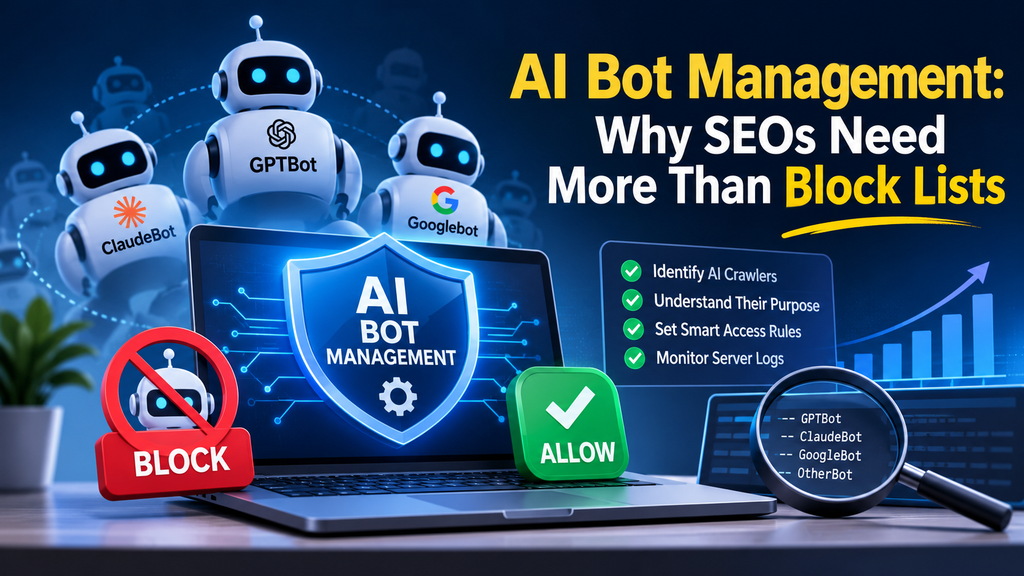
In this article, I’ll show you why blocking AI bots is insufficient and how website owners can better control these bots.
What Is AI Bot Management?
AI bot management involves recognizing AI crawlers, determining their authenticity, and determining who they can access the site.
GPTBot and ClaudeBot are linked to AI platforms, for instance. Depending on the purpose of the crawler and the rules of access of the website, they can visit publicly accessible pages to collect information.
That’s where care needs to be taken by website owners. Not all the crawlers are used for the same purpose and not all businesses are the same.
Consider a website that has a blog for education. Its owner may desire AI platforms to identify and cite that content. Alternatively, if a business has sensitive or commercially valuable content, it may want to limit some of the crawlers.
Both can be right decisions.
The key is to be aware of what and why you’re letting it in.
If a simple blacklist is not sufficient, why not?
One of the first things that website owners typically think of when they see or hear about AI crawlers is to add their names to the robots.txt file.
Using robots.txt is fine, but relying solely on robots.txt can be problematic.
I’ve seen a lot of people make some of these mistakes when I look at AI bot management.
The ability to depend on a Small List of Bot Names.The ability to rely on a Small List of Bot Names.
The technology of AI is evolving rapidly and new crawlers are emerging with time. Companies may also have various bots with different functions.
Other crawlers may be unable to gain access to your website if you only allow a few well-known crawlers to access your site.
2. Blocking Bots Without Understanding Their Purpose
Not all AI crawlers are alike. Some are related to AI training, others could be used for search discovery or other services.
Preventing GPTBot or ClaudeBot access to sites without knowing what they do may be a bad idea, particularly if you value the visibility of your websites on search engines.
But did you consider robots.txt to be the ultimate solution?But have you ever thought that robots.txt gives 100% protection?
It is an important thing website owners should be aware of.
Robots.txt is used to inform the compliant robots what parts of a website to avoid. It is not a password or firewall, however, that prevents access.
Some bots will obey these instructions, others won’t.
It’s also important to note that the Robots Exclusion Protocol (RFC 9309) explicitly states that robots.txt is not an access-control mechanism.
If protection is required, you might want to try server-level or firewall controls.
Making Changes Without going to the Server Logs
Not all rules can be put inside the robots.txt file.
What occurs then?
Is the bot doing what you want? Are there still people crawling your pages who you don’t know? Is there any bot that is making unnecessary requests?
These questions can only be answered with difficulty without going into the server logs.
One more item to note is Google-Extended. It’s not a different crawler that you will see in server logs. It is a robots.txt control token for some AI purposes in Google. Therefore, it is important to be aware and understand it differently from the other crawlers like GPTBot and ClaudeBot.
A Practical Approach to AI Bot Management
I don’t want to stop all the AI crawlers, I would rather see it a step at a time. This allows for a greater comprehension of what’s going on before any adjustments are made.
The first step in troubleshooting is to identify which crawlers are visiting your site.Knowing what kind of crawlers are coming to your site is the first step in a troubleshooting.
The first place that I’d look is in the access logs of the website’s server.
These logs can be used to determine which user-agents are accessing your pages, how often they do it and which pages they are accessing.
Search for the following names:
– GPTBot
– ClaudeBot
– Googlebot
Any other known AI crawler
Watch for how frequently they visit. If a bot is consistently and quickly accessing the same pages, for instance, it might be worth investigating.
This step will help you get a better understanding of how the crawler performs rather than a blind guess.
Next, determine if the crawlers are legitimate.Finally, confirm if crawlers are legitimate.
It is worth noting that a bot’s name is not a good indicator of its identity:
A request can be made by any entity, with a familiar user-agent name. This could result in a malicious bot masquerading as GPTBot or one of the known crawlers.
To prevent such a blunder, look at some things:
Check | What should you look for? | Tools |
|—|—|—|
Looking for a freelance digital marketer in Palakkad to grow your business online? I help businesses, startups, and personal brands build a stronger digital presence through practical and result-focused digital marketing strategies. From SEO and social media marketing to Google Ads, content marketing, and website optimization, I provide customized solutions based on your business goals.