Introduction
If you thought Google AI Overviews only pulled from websites, news articles, and traditional search results, a fresh look at 300 million US searches suggests otherwise. Google AI Overviews social media sources — specifically Facebook, Instagram, and TikTok — are showing up far more often than most marketers expect.
This isn’t just a technical curiosity. It changes how businesses should think about social media, shifting it from a pure engagement channel to a potential input for AI-generated search answers. Below, I’ll break down what this actually means, what I’ve seen in practice, and how to adjust your strategy without falling for hype.
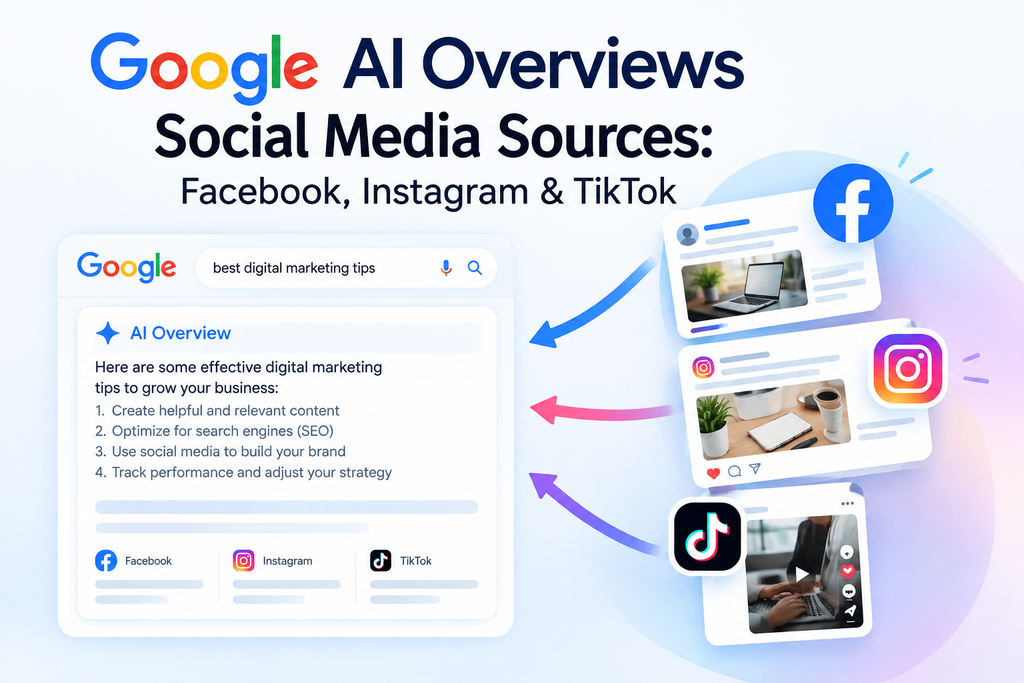
Table of Contents
What the Data Actually Shows
The core finding is simple but significant: across a massive sample of US searches, Google’s AI Overviews (AIOs) are referencing content that originates from social platforms, not just conventional web pages. Facebook, Instagram, and TikTok all appear as contributing sources in a meaningful share of these AI-generated answers.
This matters because most SEO strategies still treat social media and search as separate worlds. One is for visibility and community; the other is for rankings and traffic. That separation is getting blurrier. Social profiles are increasingly becoming part of the broader information ecosystem that AI search systems draw from when trying to understand a business, product, or topic.
Why This Is Surprising — And Why It Makes Sense
The surprising part isn’t that social platforms exist online — it’s that AI Overviews are pulling from them at all, given how much of Google’s traditional algorithm has favored structured websites, authoritative publishers, and news sources.
But it starts to make sense once you consider what social profiles actually contain: business names, locations, service descriptions, customer interactions, reviews, and real-world context. That’s exactly the kind of information an AI system needs to answer questions like “what does this business do” or “where is this located.” Social platforms have effectively become large, semi-structured databases of business and product information — and AI Overviews appear to be tapping into that.
Has This Actually Happened? A Grounded Take
It’s tempting to claim a dramatic before-and-after story here, but I want to be transparent: I haven’t personally verified a specific case of one exact social post getting directly cited in a Google AI Overview, and I’d be cautious about anyone who claims certainty on that without proof.
What I have seen is a pattern that fits the data. When a business keeps consistent information — the same services, location, and description — across its website and its Facebook, Instagram, and TikTok profiles, that consistency seems to reinforce how clearly search systems (AI or otherwise) understand the business. Social media works best here as a supporting signal, not a guaranteed citation source.
What Kind of Social Content Seems to Matter Most
Rather than one specific content format, it comes down to how useful and specific the information is. Based on patterns worth watching:
- Business information posts – services offered, location, hours, and product details
- Reviews and comments – these add real-world context and credibility
- Explainer-style posts – content that clearly describes what a product or service does and who it’s for
- Consistent profile details – business name, description, and contact info that match the website exactly
The common thread is clarity and accuracy, not engagement metrics like likes or shares. A post doesn’t need to go viral to be useful — it needs to be factually clear and consistent with everything else the business has published elsewhere.
Practical Steps for Small Businesses
If you’re a small business owner or run marketing for one, here’s where to start:
- Audit and standardize your profiles. Make sure your business name, website URL, location, services, and description are identical across Facebook, Instagram, and TikTok.
- Answer real customer questions in your posts. Cover what you offer, where you operate, who you serve, and how your process or pricing works.
- Prioritize consistency over volume. You don’t need to post daily. You need your information to be accurate, clear, and aligned everywhere it appears.
- Treat reviews and comments as an asset. Encourage genuine customer feedback — it adds real-world context that supports how AI systems and search engines understand your business.
This is a case where slow, deliberate cleanup often beats aggressive content output.
The Mistake That Undermines This Strategy
The most common mistake I see is treating social media as a purely promotional channel — endless “buy now,” “DM us,” or generic offer posts with no real substance about the business itself.
The second, related mistake is inconsistency: a different address on Facebook than on the website, an outdated service list on Instagram, or a business description on TikTok that doesn’t match anywhere else. These conflicting signals make it harder for any system — AI-powered or not — to build an accurate picture of the business.
If your goal is better social media visibility in AI search results, promotional noise and inconsistent details work directly against you.
Google AI Overviews vs. Traditional SEO Signals
| Factor | Traditional SEO | Google AI Overviews (Social) |
| Primary source type | Websites, news, structured data | Websites + social profiles (FB, IG, TikTok) |
| Key signal | Backlinks, on-page optimization | Consistency of business info across platforms |
| Content goal | Rank for keywords | Provide clear, verifiable, structured information |
| Update frequency | Periodic content updates | Ongoing accuracy across all profiles |
FAQs
Does posting more on social media guarantee my business shows up in Google AI Overviews?
No. Based on current patterns, consistency and clarity of business information matter more than posting frequency.
Which platform matters most — Facebook, Instagram, or TikTok?
There’s no single “best” platform. What seems to matter more is that your information is accurate and consistent across all the platforms you use.
Should I stop making promotional posts entirely?
Not entirely — but balance them with posts that clearly explain your services, location, and value, since this is the type of content that appears to support AI Overviews social media sources.
Conclusion
Google AI Overviews social media sources are a reminder that SEO and social media strategy are converging faster than many businesses realize. Facebook, Instagram, and TikTok aren’t just engagement tools anymore — they’re becoming part of the information landscape that AI systems use to understand who you are and what you offer.
The actionable takeaway is straightforward: audit your social profiles for consistency, fill them with clear and useful business information, and treat accuracy as a ranking factor in its own right. You don’t need to chase every AI search trend — you need your business information to be honest, clear, and the same everywhere it appears.
Looking for a freelance digital marketer in Palakkad to grow your business online? I help businesses, startups, and personal brands build a stronger digital presence through practical and result-focused digital marketing strategies. From SEO and social media marketing to Google Ads, content marketing, and website optimization, I provide customized solutions based on your business goals.