If you’ve ever wondered why a page that ranks #1 on Google never comes up when you ask ChatGPT the same question, you’ve already run into the core problem that Generative Engine Optimization (GEO) exists to solve.
For years, SEO has been about rankings, keywords, and backlinks. But AI search engines aren’t just ranking pages anymore — they’re reading, interpreting, and deciding what to say on your behalf. That’s a fundamentally different game, and it took a real client situation for this to click for me. GEO by Engine helps explain why platforms like ChatGPT, Claude, Gemini, and Perplexity can interpret and surface information differently, even when they’re answering the same question.
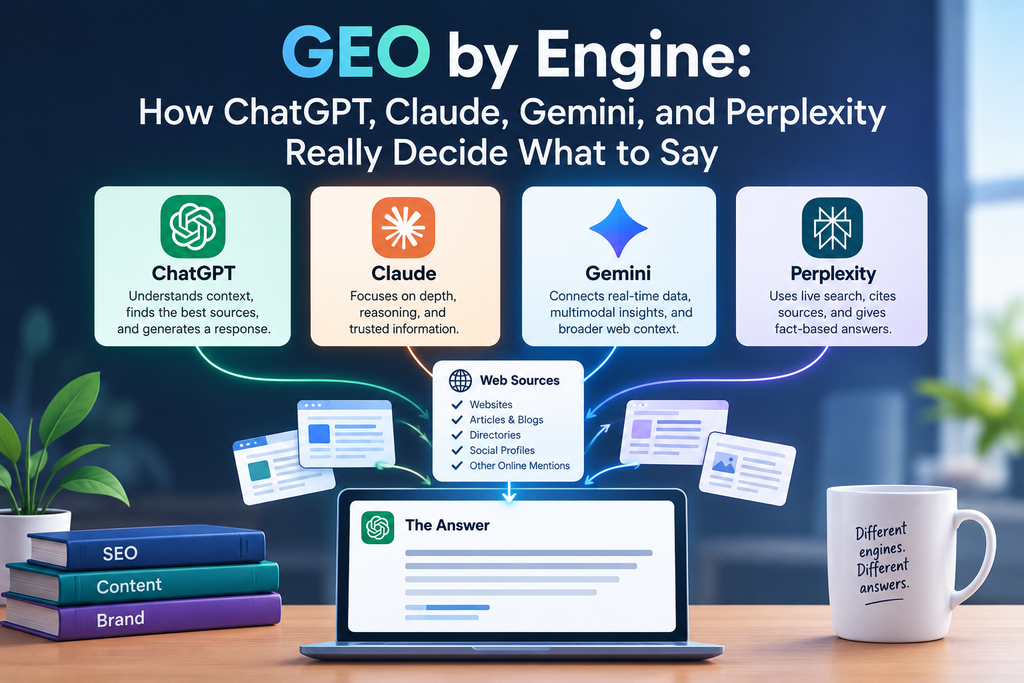
Table of Contents
What Is GEO by Engine? How Generative Engine Optimization Differs from SEO
The shift became obvious when I noticed that ranking well on Google didn’t guarantee an AI tool would mention the same business when answering a related question. With traditional SEO, the focus is on keywords, search intent, and where a page lands in the results. With GEO by Engine, the question changes: can an AI system clearly understand this business, connect the right information from different sources, and confidently use it in an answer?
That’s the real distinction behind GEO vs SEO. SEO is about helping a page perform in search results, while GEO by Engine focuses on how AI systems understand and represent a business. AI search engine optimization asks something broader — whether an AI system can correctly understand the entity, the services, the expertise, and the context sitting behind those pages. In simple terms, GEO by Engine is about making your business information clear and reliable enough for AI systems to understand and use when generating answers.
A Real Example: When AI Search Confused a Client With a Competitor
The clearest case I’ve worked on involved a local digital marketing business. When we tested the brand across AI search tools, the problem was obvious immediately — the AI sometimes confused the business with a different company entirely, returning the wrong location, services, or background.
Instead of trying to manipulate the AI directly, I focused on making the business’s information more consistent and easier for AI systems to parse. That meant reviewing the website content, business details, service pages, social profiles, and other online references, and tightening up anywhere the identity, services, or location were unclear or contradictory.
I also rewrote key content with a GEO lens — not optimized purely for keyword rankings, but structured so the important facts were easy to extract, with direct answers to the questions potential customers would actually ask. After retesting across AI tools over time, the responses became noticeably more accurate.
The lesson: GEO isn’t about getting one AI tool to mention a brand once. It’s about building a consistent, trustworthy information footprint that gives AI systems better material to work with.
How Each AI Engine Actually Behaves (With a Caveat)
It’s tempting to look for a single trick that works across every AI platform. In practice, I’ve found it’s smarter to treat each one differently — while staying honest about how much of this is genuinely knowable from the outside.
How Perplexity Ranks Answers
Perplexity tends to surface its sources more visibly than other engines, which makes it easier to see exactly which pages are backing up a given answer.
How ChatGPT Chooses Sources
ChatGPT’s behavior shifts depending on the mode and whether web search is active. Clear, authoritative information tends to matter more here than repeating keywords.
How Gemini Decides What to Cite
Gemini appears to draw from a broader ecosystem of sources, which makes consistency across different platforms — not just your own website — more important.
How Claude Generates Responses
Claude’s output depends heavily on the information available to it within the specific context it’s given, rather than a fixed retrieval pattern.
One honest caveat worth stating: none of these systems publish their exact retrieval or ranking logic, and they change over time. I’d be cautious about anyone claiming to know precisely how ChatGPT, Claude, Gemini, or Perplexity always weigh source types — the safer bet is optimizing for clarity and consistency rather than chasing platform-specific hacks.
The Biggest GEO Mistake (And What to Do Instead)
The most common mistake is treating GEO like SEO with an AI wrapper slapped on top — taking an existing article, adding a phrase like “according to AI,” bolting on a few FAQ sections, and expecting ChatGPT or Perplexity to start citing the brand. This approach misses what GEO by Engine is really about: understanding how different AI platforms interpret, evaluate, and use information.
The real first question should be: does the information about this business actually make sense to an AI system? With GEO by Engine, this becomes even more important because ChatGPT, Claude, Gemini, and Perplexity may process and present information differently. If the website says one thing, social profiles say another, directories are outdated, and different pages describe the business inconsistently, no amount of extra keywords fixes that.
Instead of trying to write content that “tricks” an AI into citing a page, focus on the fundamentals of GEO by Engine:
- Making the subject and entities clear
- Answering questions directly
- Providing useful, original information
- Keeping important facts consistent across every source
- Building topical authority instead of publishing large volumes of thin content
- Regularly checking how different AI platforms actually describe the business
The shift in mindset matters more than any single tactic. GEO by Engine is not simply about getting AI to mention a keyword. It is about making your business information clear, consistent, useful, and easy for AI systems to understand. Stop asking, “How do I make AI mention my keyword?” and start asking, “Why would an AI system consider this information useful and trustworthy enough to include?”The shift in mindset matters more than any single tactic: stop asking “how do I make AI mention my keyword” and start asking “why would an AI system consider this information useful and trustworthy enough to include?”
How to Start Doing GEO Today: A Simple AI Visibility Audit
Before changing anything, start with a baseline AI visibility audit. A useful GEO by Engine approach is to take your main service, product, or business name and ask several AI platforms the kinds of questions your potential customers would actually type or say. Since GEO by Engine can vary between ChatGPT, Claude, Gemini, and Perplexity, checking more than one platform gives you a clearer picture of how your brand appears across different AI search experiences.
- “Who are the best [service] providers in [location]?”
- “What does [business name] do?”
- “Which companies provide [specific service]?”
- “What are the main services offered by [business name]?”
Record what each engine says, which sources it references, and whether the information is accurate. Then compare those answers against your website and other key online profiles. This GEO by Engine comparison can help you identify differences in how each AI platform understands your business, looking specifically for:
- Missing information
- Conflicting descriptions
- Outdated details
- Services the AI doesn’t seem to understand or mention
- Differences in how each engine describes your business
The goal of GEO by Engine is not simply to see whether your business appears in AI answers. It is to understand how ChatGPT, Claude, Gemini, Perplexity, and other AI engines interpret your brand, where their information comes from, and what may be causing inaccurate or incomplete answers.tems are likely pulling from.
FAQs
Is GEO replacing SEO?
No. GEO builds on the same foundation of clear, trustworthy content — it just extends the goal from ranking pages to being correctly understood and cited by AI systems.
Do ChatGPT, Claude, Gemini, and Perplexity all rank sources the same way?
No, and it’s worth being skeptical of anyone who claims certainty here. Each platform behaves differently, and none of them fully disclose their retrieval logic.
What’s the fastest way to know if GEO is even a problem for my business?
Run the baseline AI visibility audit above — ask AI platforms what they know about your business and compare it against reality.
Conclusion
Generative Engine Optimization isn’t about gaming any single AI engine — it’s about making a business’s identity, services, and expertise unmistakably clear across every source an AI system might draw from. Start with an honest audit of what AI already says about you, fix the inconsistencies you find, and build content that answers real questions directly. That foundation will serve you regardless of how ChatGPT, Claude, Gemini, or Perplexity’s algorithms shift next.
Looking for a freelance digital marketer in Palakkad to grow your business online? I help businesses, startups, and personal brands build a stronger digital presence through practical and result-focused digital marketing strategies. From SEO and social media marketing to Google Ads, content marketing, and website optimization, I provide customized solutions based on your business goals.